Broadest real-world look at GLP-1 diabetes drugs confirms heart and kidney benefits, flags joint, gut and sleep signals to watch
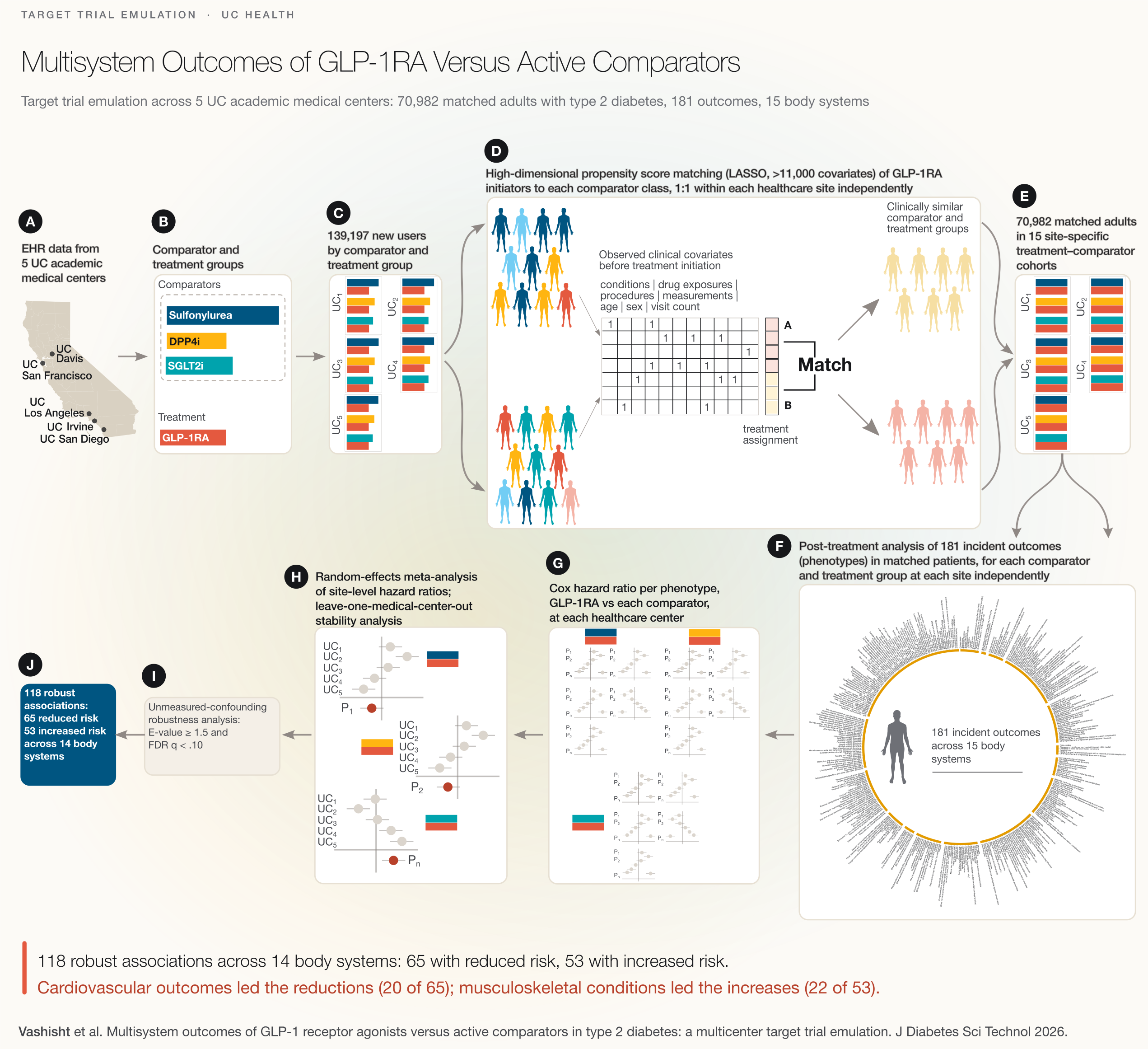 Real-world study of nearly 71,000 matched adults across five University of California medical centers screened 181 health conditions across 15 body systems
SAN FRANCISCO — GLP-1 receptor agonists, the drug class that includes semaglutide, liraglutide and dulaglutide, were linked to lower risks of heart attack, heart failure, blood clots and kidney disease in people with type 2 diabetes compared with three other commonly prescribed diabetes medicines, according to a new study published in the Journal of Diabetes Science and Technology. The same analysis also found potentially higher risks of several conditions that are not routinely tracked in clinical trials, including osteoarthritis, back problems, and sleep disorders.
Researchers from the UC San Francisco analyzed de-identified electronic health records from five independent University of California academic medical centers including UC San Francisco, UC San Diego, UC Davis, UC Irvine and UCLA from 2012 to 2025. Rather than focusing on one disease, the team used a “hypothesis-free” approach, screening 181 conditions across 15 body systems, with up to five years of follow-up.
“Randomized trials of these drugs are usually short and designed around a single heart or kidney outcome, but patients take them for years and the drugs may affect many organs,” said Rohit Vashisht, PhD, Assistant Professor of Medicine at the Department of Epidemiology and Biostatistics and the Bakar Computational Health Sciences Institute at the University of California, San Francisco and lead author of the study. “We wanted a full-body scan of what happens in routine clinical care, compared against the medicines patients would otherwise receive.”
How the study worked
The team used target trial emulation, a method that structures and analyzes observational data to potentially mirror a randomized trial. Adults newly starting a GLP-1 receptor agonist were compared, one-to-one, with similar patients starting a sulfonylurea, an SGLT2 inhibitor or a DPP-4 inhibitor. Patients were matched within each medical center on more than 11,000 health characteristics drawn from their records, and only new diagnoses arising after treatment began were counted. Results from each center were then combined, and a finding was counted as robust only if it held up when any single center was removed, was strong enough to resist plausible unmeasured confounding, and passed a strict correction for testing many outcomes at once.
“Target trial emulation lets us ask a trial-style question of routine health records. We spell out who is eligible, when treatment starts and how patients are followed, just as a randomized trial would, and then apply that protocol to real-world data,” Vashisht said. “It doesn’t replace randomized trials, but it avoids many classic pitfalls of observational research and lets us study longer follow-up, broader populations and far more outcomes than any single trial could.”
“This kind of hypothesis-free, phenome-wide screen lets the data tell us where to look next,” said co-author Marina Sirota, PhD, Professor and Interim Director of the UCSF Bakar Computational Health Sciences Institute. “Requiring every signal to replicate across five independent centers and survive several stress tests is what separates a credible lead from noise.”
“This study shows what’s possible when five academic health systems harmonize their data responsibly,” said Cora Han, JD, Chief Data Health Officer at UC Health Center for Data-driven Insights and Innovation. “UC Health can now answer questions about patient safety and effectiveness at a scale and diversity no single institution could reach on its own.”
Key findings
Of 482 drug-comparison results, 118 met every robustness test: 65 pointed to lower risk and 53 to higher risk with GLP-1 receptor agonists.
-Lower risk: myocarditis and cardiomyopathy (62% lower vs SGLT2 inhibitors), heart attack (47% lower vs SGLT2 inhibitors), heart failure (29% lower vs DPP-4 inhibitors), blood clots (about 30% lower vs all three comparators), kidney disease (27% lower vs SGLT2 inhibitors), several lung conditions, anemia and tobacco-related disorders.
-Higher risk: osteoarthritis (up to 48% higher), stress fractures (68% higher vs sulfonylureas), low back pain and spine conditions, diverticular disease (18%–33% higher), sleep-wake disorders (27%–54% higher) and menopausal disorders.
-Consistency: five reduced-risk and seven increased-risk conditions appeared against all three comparator drugs, suggesting patterns that hold across the drug class. Of 26 findings checked against published trials, 19 agreed in direction.
“It was reassuring to see the heart and kidney evidence seen in clinical trials replicated in everyday care across five health systems,” Vashisht said. “That gives us confidence the method works, and the new signals may be worth exploring further.”
The heart and kidney results align with major outcome trials such as LEADER, SUSTAIN-6, REWIND, SELECT and FLOW, and notably held up even against SGLT2 inhibitors, which have shown favorable heart and kidney outcomes in trials. The study did not test mechanisms, but the musculoskeletal signals may relate to loss of muscle mass that can accompany GLP-1-related weight loss, while the gastrointestinal findings may be consistent with the drugs’ known slowing of bowel movement.
“Seeing lower rates of cardiomyopathy compared with SGLT2 inhibitors, a class with proven cardiovascular benefit, is important,” said co-author Sanket S. Dhruva, MD, MHS, Associate Professor of Medicine at UCSF and a cardiologist at the San Francisco VA Health Care System. “Head-to-head comparisons of these drugs that patients receive are exactly the evidence clinicians and regulators need.”
“The key messages from this study are reassuring, as they mirror several important outcomes noted in randomized trials,” said co-author Suneil Koliwad, MD, PhD, Chief of the UCSF Division of Endocrinology and Metabolism. “As millions more people start these medicines, our findings highlight that clinicians will likely have to keep an eye on joints, bones, bowel health and sleep, as these are areas of risk that are also starting to emerge in the context of clinical trials.”
Important limitations of the study
The study is observational and describes patterns in routine health records, and the authors describe the findings as hypothesis-generating. Many factors not captured in the records, such as diet, physical activity or income, could differ between patient groups, and patients on GLP-1 drugs may simply be checked more often. Diagnoses came from billing codes, the data reflect academic medical centers in California, and the study could not assess specific drugs, doses or newer agents such as tirzepatide. The researchers call for prospective studies with carefully confirmed endpoints in the areas identified.
“Real-world data from routine care can surface signals that trials were never designed to detect, but they are a starting point, not the final word,” said Vashisht. “The next step is to test these findings prospectively and build them into how health systems monitor patients on these drugs.”
“As GLP-1 drugs expand into new uses, studies like this can act as an early-warning and early-opportunity system, flagging both potential harms and potential new benefits,” said co-author Karandeep Singh, MD, MMSc, Joan and Irwin Jacobs Chancellor’s Endowed Chair in Digital Health Innovation and Associate Professor in Biomedical Informatics at UC San Diego Health.
About the study
“Multisystem Outcomes of GLP-1 Receptor Agonists Versus Active Comparators in Type 2 Diabetes: A Multicenter Target Trial Emulation” is published in the Journal of Diabetes Science and Technology (DOI: 10.1177/19322968261498914). Authors: Rohit Vashisht, Sanket S. Dhruva, Ayan Patel, Lisa Dahm, Pagan Morris, David Gonzalez, Rob Follett, Marina Sirota, Karandeep Singh, Suneil Koliwad and Cora Han. The authors report no conflicts of interest.